Search isn’t just about ranking on Google anymore. Today, brands are competing for visibility on AI search engines, voice assistants, and conversational platforms. Digital discovery rules are rapidly evolving, and companies that don’t adapt risk disappearing online.
It was not so long ago that a website would be able to reach the top of search engine results by adding the keywords to its blog and creating backlinks. But today? Users are using ChatGPT to ask for recommendations, asking voice assistants to show them a service, and using AI-generated answers rather than scrolling through 10 blue links.
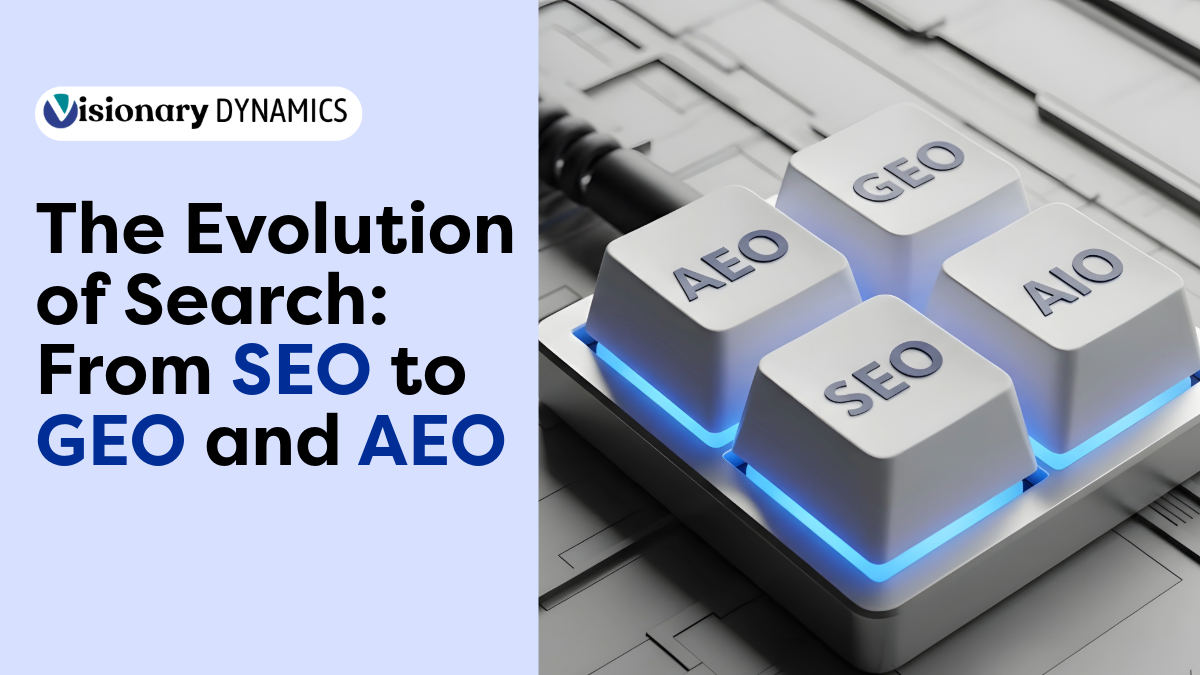
This is the reason companies are now discussing SEO, GEO, and AEO simultaneously.
This is a reality we’ve experienced at Visionary Dynamics, assisting businesses in enhancing their online strategies, customer interactions, and digital presence. Search optimization is changing the game from merely ranking, and companies are required to have a smarter approach to the content for them to be competitive.
What Is SEO?
Optimizing a website for search engines, such as Google and Bing, is called Search Engine Optimization (SEO). The objective is quite straightforward: rank higher, get organic traffic, and turn traffic into customers.
So, SEO has been emphasizing the following for years:
- Keyword optimization
- Backlink building
- Technical SEO
- Mobile optimization
- High-quality content
- User experience
But the truth is, SEO is still relevant — big time.
Even with the search query of a phrase like “best accounting services” or “IT management solutions”, optimized websites still appear at the top of the search results. However, consumers’ behaviour has completely evolved. Today’s consumers demand conversational interactions, personalized recommendations, and faster answers.
GEO and AEO come in handy then.
The Shift in Search Behaviour
Consider your personal behaviour.
If you were looking for information, you were likely to go through a process similar to this several years ago:
The name of the top virtual business assistants for small businesses. The title of the best virtual business assistants for small businesses.
Today, many users ask the following:
- “ChatGPT, what’s the best virtual assistant service for startups?”
- “Alexa, find a nearby accounting consultant.”
- “Google, summarize the best AI customer support tools.”
The search experience is moving towards a conversational and AI-centric approach.
This happened firsthand to me when I assisted a friend in starting an e-commerce business last year. We optimised our product pages for weeks for SEO. Even though traffic began to improve, another curious thing occurred — Customers began to share that they found the brand via AI-led recommendations or voice search and not solely because of Google rankings.
One thing became apparent at that moment: traditional SEO is no longer sufficient.
What Is GEO (Generative Engine Optimization)?
Generative Engine Optimization (GEO) is a new approach for optimizing content for AI search engines such as ChatGPT, Gemini, Claude, and Perplexity.
These websites provide instantaneous answers based on data from various sources and don’t just rank web pages.
GEO can be a part of those AI-generated responses.
Why GEO Matters
The rise of AI-powered search is gaining significant momentum due to the following factors:
- Faster answers
- Personalized responses
- Conversational interactions
- Simplified information discovery
AI systems are more likely to cite your business content, as the information is clear, trustworthy, well-organized, and authoritative.
This alters the way content is written.
Now, businesses don’t write just for algorithms; they write for:
- Human readers
- AI models
- Conversational search engines
GEO Best Practices
To improve visibility in AI-driven search:
Create Deep, Helpful Content
Blogging at the surface level is no longer effective. AI platforms prioritise content that is of value in solving problems.
Use Conversational Language
The way people search is different in AI tools. Robotic keyword stuffing is not as important as natural language.
Build Brand Authority
AI systems favor credible brands that are knowledgeable and frequent.
Structure Content Clearly
Use:
- H2 and H3 headings
- Bullet points
- FAQs
- Simple explanations
This simplifies the comprehension of content for AI systems.
We pay a lot of attention to developing content strategies at Visionary Dynamics that are structured and designed with the person in mind, rather than keyword repetition, because today’s search engines value clarity and usefulness over repetition.
What Is AEO (Answer Engine Optimization)?
Answer Engine Optimization (AEO) is a method of optimizing content with the direct answers in mind.
This includes:
- Featured snippets
- Voice search results
- AI-generated summaries
- Google’s “People Also Ask”
- Smart assistants like Siri and Alexa
The objective is to deliver fast and correct answers that can be ingested in a timely fashion.
The Rise of Zero-Click Searches
When users find answers without clicking on a website, it’s usually from the search results.
For example:
You can find the answer by asking the question, “What is AEO?”
Google might automatically show ‘AEO (Answer Engine Optimization): AEO is used for content to be featured in direct search answers.
No website visiting needed.
I don’t feel that’s a bad thing; some marketers do. When businesses become the trusted source for answers, they get more authority sooner than businesses that do not follow these changes.
SEO vs GEO vs AEO: What’s the Difference?
|
Strategy |
Main Focus |
Platforms |
Goal |
|
SEO |
Search rankings |
Google, Bing |
Increase website traffic |
|
GEO |
AI-generated responses |
ChatGPT, Gemini, Perplexity |
Improve AI visibility |
|
AEO |
Direct answers |
Voice search, snippets |
Deliver instant answers |
The future isn’t about choosing one over the other.
The smartest brands combine all three.
Why Businesses Must Adapt Now
It’s 2018 again, and many companies are still operating as if it’s 2018. They write general blogs rich in keywords and hope to get page 1 rankings.
That’s a strategy that is rapidly declining.
In modern search optimisation, the following is necessary:
- Authority-driven content
- Human-centered storytelling
- Conversational writing
- Technical optimization
- AI-friendly formatting
Those who adapt first get a tremendous competitive edge.
Digital strategy, analytics, automation, and intelligent content planning are all key components of Visionary Dynamics’ approach to helping businesses stay ahead of the curve.
The Human Side of Search Optimization
A common error I see is brands getting caught up in algorithms instead of people.
Great content is not only optimized, but it’s also connected.
There are two blogs that I read a few months ago about the same subject. One was stuffed with keywords and was robotic. The common real examples, personal experiences, and practical tips are
I can’t remember which one I was thinking of.
The second one.
This is where current optimization is going. Search engines and AI systems are increasingly favouring content that exhibits expertise, authenticity, and genuine human value.
How to Future-Proof Your Content Strategy
1. Focus on Experience, Not Just Keywords
While keywords are important, user intent is even more important.
Provide answers to actual questions.
2. Build Topic Authority
Don’t publish random blogs, but rather groups of blogs to focus on a specific topic.
For example:
- SEO strategy
- AI search optimization
- Voice search
- Digital transformation
3. Optimize for Conversations
Think about how people actually speak.
Instead of “best CRM software”.
Users may ask:
“What’s the best CRM software for small businesses?”
4. Use Structured Formatting
AI systems prefer organized content with:
- Headings
- Lists
- FAQs
- Concise explanations
5. Prioritize Trust
Google and AI platforms increasingly value:
- Expertise
- Accuracy
- Brand credibility
- Helpful information
The Future of Search Is Already Here
Search optimization extends beyond search engine optimization.
The digital world has developed to encompass the following:
- AI assistants
- Voice search
- Conversational AI
- Predictive search experiences
SEO was the first to open the door. GEO and AEO are forging the future.
The future of online visibility belongs to businesses that evolve now.
The brands that will emerge as the winners tomorrow will not just be there; they will be the trusted brands users will hear, read, and interact with across all digital platforms.
You know, that’s what real search optimization is all about these days—the idea of being genuinely helpful wherever your audience is looking!
FAQs
1. What is the difference between SEO, GEO, and AEO?
SEO focuses on improving search engine rankings and organic website traffic. GEO focuses on visibility within AI-generated responses, while AEO focuses on providing direct answers for featured snippets, voice search, and other answer-based search experiences.
2. Why is GEO important for businesses?
GEO helps businesses adapt their content for AI-driven search platforms such as ChatGPT, Gemini, Claude, and Perplexity. Clear, useful, well-structured, and authoritative content can improve a brand’s visibility in AI-generated responses.
3. How can businesses optimize content for AEO?
Businesses can optimize for AEO by providing clear and direct answers to common questions, using conversational language, organizing content with headings and lists, and creating FAQ sections that address specific user queries.
4. Is traditional SEO still important with the rise of AI search?
Yes. The article explains that SEO remains relevant for traditional search engines such as Google and Bing. GEO and AEO expand the optimization approach rather than simply replacing SEO.
5. How can businesses future-proof their search optimization strategy?
Businesses can focus on user intent, build topic authority, create conversational content, use structured formatting, and prioritize expertise, accuracy, and credibility. Combining SEO, GEO, and AEO can help content remain useful across different search experiences.